 |
| Angel showing Yudhishthira around Hell! |
Showing posts with label Reading Diary. Show all posts
Showing posts with label Reading Diary. Show all posts
Saturday, April 18, 2015
Week 14 Reading Diary: The End of the Mahabharata
My favorite part of this reading is Yudhishthira's dream. It was very touching to see him journey with his brothers, their wife and a dog. Everyone dies, but he continued on with the journey showing great compassion to the dog. Due to his compassion Yudhishthira is able to go to heaven and hell as a mortal, which is super crazy to think about! What a great experience that must have been for him to see heaven, and how terrifying it must have been to go through Hell!
I also found it extremely honorable how Arjuna ends his warrior life by bringing his weapons to the fire god Agni to be burned! The Mahabharata ultimately ended with the Pandavas leaving the world, leaving Parikshit as the last remaining heir of the Pandavas.

Week 14 Reading Diary A: The End of the War
This reading was much less intense then last weeks, but still had a fair amount of battle and death. It was such a relief to see Duryodhana defeated, but it was very frustrating to see Ashwatthaman become the leader of his army. To me it seemed like Ashwatthaman was operating solely out of rage and revenge, and that seems like a poor person to put in charge of an entire army! Ashwatthaman ends up wiping out basically the entire Pandava army (besides the brothers), and it led to the war being stirred back up once more! I really enjoyed reading about the war taking place in the previous reading, but at this point I wasn't really enjoying it anymore. Ashwatthaman was stoking a flame that could have easily died out, and the war ended. I'm glad my favorite character Arjuna came in with his incredible weapons to take on Ashwatthaman for the final fight. Arjuna is able to cancel out Ashwatthaman's weapon and Vyasa and Krishna recall the weapons and the war ends up finally coming to an end. There are funerals for all the powerful men that died in the war which really bummed me out because I felt like the war was so pointless in the first place!
 |
| Bhima defeating Duryodhana |
Wednesday, April 8, 2015
Week 12 Reading Diary B: The Pandava's Exile
My favorite character thus far in Buck's Mahabharata is Arjuna. To me he seems to be one of the most manly characters, and is extremely honorable. He is already an extremely skilled warrior, but in this weeks reading he learns musical talents as well as dancing. On top of that Indra teaches him the use of divine weapons, which I think is crazy because Arjuna is already one of the most skilled warriors aside from Karna. He showed that he was honorable by refusing the advances of Urvashi, and she curses him which turned out to be something that would benefit him for his thirteenth year of exile. Arjuna just seems to have everything going for him and is certainly my favorite of the brothers!
The only other part that I really enjoyed in this reading was the tale of Savitri. It was such an incredible story of love and the bravery that can come from loving someone. She chose a husband that she knew didn't have much time to live, but loved him dearly. When he died Yama came for his soul and Savitri was so courageous that she wanted to follow him. Yama granted her a wish and instead of something selfish, Savitri thought to cure the blindness of her father in law! Then as a second wish she requested 100 sons for her father in law, and as a third she requested 100 sons with her husband. Yama said she would have to forfeit half her days and give them to her husband, which she gladly did. This story was so touching, because not only did Savitri show incredible love and courage, but she was incredibly selfless!
 |
| Arjuna the Mighty Warrior! |
Wednesday, March 25, 2015
Week 10 Reading Diary B: An Epic Battle
This reading was extremely interesting to read for me. I always enjoy the action packed moments in books, so this great scene of war was awesome. It was certainly my favorite part of the Mahabharata. Although the preparations for war were basically complete, Yudhishthira wisely desired one last plea for peace. I truly grew to respect Yudhishthira as a leader, and admire that his heart wasn't for violence unless it was a last resort. The plea for peace fails and a war begins between the Pandavas and Duryodhana. The battle is intense and my favorite warrior is Arjuna. Initially Arjuna was worried about fighting his old Guru Drona, but Krishna inspires him with a divine prayer and Arjuna is ready for battle. Arjuna fought valiantly and ended up killing Bhishma, the commander of Duryodhana's army! Bhishma's death leads to Karna joining the fight. Arjuna's son is then captured and killed which leads to Arjuna going on a rampage and killing Jayadratha in an act of revenge! Arjuna's strength is incredible and was amazing to read about. I was certain he would continue to excel in this war, and perhaps even bring an end to it all. Ultimately Arjuna defeats Karna in an intense one on one duel, which cripples Duryodhana's army and essentially ends the war!
After the great battle Yudhishthira becomes king and eventually all the Pandava's died off leaving only the child of Abhimayu, Arjuna's son, to continue the Pandava line.
 |
| Karna and Arjuna fighting |
Tuesday, March 24, 2015
Week 10 Reading Diary A: The Brink of War
This reading was very interesting as the Pandavas approach the final moments of their exile. Dhritarashtra hoped to cause trouble in the Pandava's exile and potentially even defeat them! To start this off Duryodhana attempts to humiliate the Pandavas in a plan that completely backfires. I think this was a silly decision considering the fact that the Pandavas obviously have Karma on their side considering all the events that have taken place thus far. After the attempt at humiliation fails the Pandavas came upon an interesting trial. Tired, hungry and thirsty they came upon a lake. As each brother approached a voice began asking questions warning them not to drink until they answered. One by one the brothers ignored the voice and died when they drank the water! I found this a little odd considering each brother probably saw the bodies of those who had already drank the water. I feel like they should have been a bit more cautious after the first brother!
Finally Yudhistra comes along and doesn't ignore the voice. He answers the questions and all the brothers come back to life! As a reward for solving this task the brothers receive the gift of disguise for their thirteenth year of exile. I was wondering how the well known Pandava brothers were going to survive in the city without being recognized for an entire year, so now it's all starting to come together! They thirteenth year approaches and the brothers enter the city disguised as average citizens. After an unfortunate chain of events, Bhima kills one of Virata's generals. Duryodhana hears of the generals death and one of his allies proposes a raid. The raid ends and the Pandavas and Duryodhana begin preparing for war! Krishna gives each side the option of one million soldiers or Krishna himself. The Pandava's wisely choose Krishna who is an avatar of Vishnu. I have a feeling I know exactly who will win this war!
 |
| Yudhistra answering the questions the voice from the lake asks |
Wednesday, March 11, 2015
Week 9 Reading Diary B: Yudhishthira's Gambling Problem and the Pandavas' Exile
Week 9 Reading Diary B: Yudhishthira's Gambling Problem and the Pandavas' Exile
I have really enjoyed reading the Mahabharata thus far. This reading really gave me a view into what a few of the different Pandava brothers are really like. Firstly Yudhishthira was crowned as king after the Pandavas recieve the great city of Indraprastha, which showed me that he was the most respected of the brothers. This made me see him as a man of great honor which really caused the next part of the story to surprise me. After Duryodhana was embarrassed at Indraprastha he began plotting his revenge on the Pandavas. His uncle Sakuni, a cunning gambler, invited Yudhishthira to play dice. The part that surprised me the most was that Yudhishthira was sucked in and staked everything the Pandavas owned including servants, women and even their shared wife Draupadi! I don't understand how a man could so clearly lose his mind and stake everything like that, but what confuses me even more his how his brothers stood by and watched! They very easily could have intervened after they lost all their treasures, or all their servants, or all their livestock. Yet they simply stood by and watched all their wealth, and even themselves, get staked!
 |
| Yudhishthira gambling |
It seemed odd to me that the brothers stood by and watched, but it also made me a little frustrated with Sakuni and Duryodhana. They clearly knew Yudhishthira had lost his way and they continued to take advantage of him. They were very deceptive and were obviously seeking an end for the Pandavas. I was relieved when Dhiritarashtra returned everything Yudhishthira lost, it made me truly see him as a man of honor (even though he returned everything based out of fear!). Sakuni was annoyed that Dhiritarashtra restored everything to the Pandavas and once more held a gambling tournament. Yudhishthira agreed once more, and ended up causing the Pandavas to be exiled for twelve years! I truly don't understand how one man can essentially stake the lives of his brothers and they just stand by and agree. It seems so foolish, and immoral! After losing that stake the Pandavas are forced into exile, and I grew to admire the brothers Bhima and Arjuna because they are mighty warriors and possess great skill with weapons. My favorite part of this reading was actually when Arjuna went to receive weapons from the gods because it is such an incredible thing to imagine! I really enjoyed this reading and can't wait to read more into the Mahabharata!
Tuesday, February 17, 2015
Week 6 Reading Diary B: Ravana's Army
Week 6 Reading Diary B: Ravana's Army
The first part of the reading was about the animals building a giant bridge over the sea (page 270). This part wasn't exceptionally exciting to me, but it was great to see all the animals working hard to accomplish the impossible! I found it rather odd that Nala's special skill is to make rocks float on water! That seemed pretty random, but it turned out to be useful! After Rama and the animals reached Lanka is when I truly began enjoying the story (page 283).
The battles between the animals and several powerful Rakshasa were intense and dragged me right into the story. My personal favorite were the encounters with Indrajit. I was impressed by Indrajit's skill as a warrior and illusionist. He summoned all the boons that Brahma promised him, which I thought were awesome: a dazzling chariot pulled by four tigers, an intricate war car, and a bow an quiver with special arrows. Indrajit had quite the arsenal at his disposal, and I was wondering how he could possibly lose! It turns out he didn't. He managed to kill nearly all the heroes of the story: Rama, Lakshmana, Nala, Angada, Sugriva, and Vibhishana (pages 310-311). This certainly didn't happen in Narayan's retelling of the story! I was really curious how things would turn out considering most of the main characters were killed, but Hanuman remained. Hanuman ended up using medicine from a hill and reviving all of the fallen soldiers, which led to a second battle with Indrajit since Rama was once again alive.
 |
| Indrajit using the boons from Brahma |
The second battle with Indrajit is much less intense and I was actually a little sad to see him slain after the conversation he had with Ravana before. Indrajit knew it was a poor idea and that the odds were against him. Since Rama was brought back from the dead he knew that Dharma was on Rama's side and there could be no victory over him. After realizing he couldn't speak any sense into Ravana he ended up going off to his death. His honorable devotion to his evil brother caused his end, and the Rakshasa lost their most powerful warrior. Vibhishana revealed Indrajit in the midst of his illusions and Lakshmana battled him eventually killing him. Ravana wept at the loss of his son, and decided that he would go to war himself. I can't wait to hear Buck's retelling of the battle between Rama and Ravana! Narayan was detailed in his retelling of that battle, but so far I have enjoyed Buck's retelling overall and have high expectations for this battle!
Week 6 Reading Diary A: Hanuman Invades Lanka
Week 6 Reading Diary A: Hanuman Invades Lanka
The first major event that happens in this reading is Hanuman's group finally discovers the location of Sita (page 219). This happened because Sampati overheard them talking about Jatayu and wanted to know what happened. Sampati was angry that Ravana had killed his brother, and disclosed that Sita was being held captive in Lanka. The group fed Sampati and his wings grew back, but for some reason he didn't fly off to attack Ravana! I really wish he did because Jatayu came very close to killing him, and Sampati would likely have been able to.
My favorite event leading up to Sita's discovery in Lanka is Hanuman leaping across the 100 leagues of ocean. The description of Hanuman's initial leap is incredible. He uproots plants with the force of the jump. As he soars through the air he was like a comet, and the air around Hanuman became electric! Many interesting things happened in the process of the leap, including a mountain rising up from the sea half way across the ocean for Hanuman to rest upon. It was certainly odd to think about mountains having wings! Then as Hanuman neared Lanka the Rakshasa Sinhika came out of the water and attempted to stop him. Sinhika opened her mouth wide, but Hanuman shrank down and flew inside of Sinhika. He crushed her heart, killing her and continued into Lanka.
 |
| Hanuman's Leap |
Once Hanuman is in Lanka he causes quite a bit of mischief. He found Sita, and had to go tell Rama but couldn't leave with out destroying some of Lanka. While this may have been immature on his part, Ravana certainly deserved it! Hanuman ended up getting captured by Indrajit, and Ravana has his tail set on fire. Hanuman then escapes from his captors and uses the fire on his tail to set fire to Lanka as he runs away. What a clever plan that was!
 |
| Hanuman burning Lanka with his tail |
My favorite character in this reading was certainly Hanuman. Not only was he the focus of this section of the Ramayana, but he exhibits a great power that he didn't even know he possessed. He leapt over 100 leagues of sea, destroyed a powerful Rakshasi and took down most of Lanka! Although he showed signs of immaturity, and overconfidence in his abilities I think overall he possesses the characteristics of a great leader and warrior. It's a shame that he isn't the leader of the monkeys!
Tuesday, February 10, 2015
Week 5 Reading Diary B: Rama and the Monkeys
Week 5 Reading Diary B: Rama and the Monkeys
This reading began with the kidnapping of Sita, and Rama's desperate search for her. Ravana was madly in love with Sita and made some very poor decisions. He was nearly killed by Jatayu while taking Sita back to Lanka, and his carelessness allowed Sita to leave a trail of evidence to aid Rama's search. He quickly found himself in the company of Savari who told him of the monkeys Sugriva and Hanuman.
Hanuman is by far one of my favorite characters in the Ramayana, and I was very glad that Buck included an in depth story about Hanuman and his origin (as well as the origin of all monkeys for that matter!). I was curious why Hanuman stuck with Sugriva in exile and how he has such great power considering he was a seemingly normal monkey, but that is not the case at all! Savari tells how Hanuman is actually the son of Vayu, the wind, and a beautiful monkey woman. He was born to be a friend that stuck by Sugriva no matter what, and has a pretty humorous story from when he was born. He actually tried to eat the sun because he thought it was fruit! As a result of the events that unfolded he was granted immortality by Brahma. It was wonderful to be given such a deep background behind Hanuman.
I also enjoyed reading about the kingdom of Kishkindhya, and how the king of the monkeys also ruled over the bears! Vali caused a strained relationship with the bear due to his arrogance, and Sugriva was outcast due to Vali's quick temper. When Vali was killed by Rama and Sugriva became king he restored the relationship between the monkeys and bears and promised Rama help after the rainy season. At the end of the rainy season Sugriva was slow to respond to Rama due to drunkenness, but eventually the leaders of the animals got together and began planning to search for Sita. It was fun imagining the massive leaders of the bears, the elegant Sugriva and powerful Hanuman all seated around a table along with Rama and Lakshmana as they strategized about how to find Sita. Overall I enjoyed the many details that were added in this section of Buck's Ramayana as compared to Narayan's. There was much more imagery, and even added characters that I enjoyed reading about.
This reading began with the kidnapping of Sita, and Rama's desperate search for her. Ravana was madly in love with Sita and made some very poor decisions. He was nearly killed by Jatayu while taking Sita back to Lanka, and his carelessness allowed Sita to leave a trail of evidence to aid Rama's search. He quickly found himself in the company of Savari who told him of the monkeys Sugriva and Hanuman.
Hanuman is by far one of my favorite characters in the Ramayana, and I was very glad that Buck included an in depth story about Hanuman and his origin (as well as the origin of all monkeys for that matter!). I was curious why Hanuman stuck with Sugriva in exile and how he has such great power considering he was a seemingly normal monkey, but that is not the case at all! Savari tells how Hanuman is actually the son of Vayu, the wind, and a beautiful monkey woman. He was born to be a friend that stuck by Sugriva no matter what, and has a pretty humorous story from when he was born. He actually tried to eat the sun because he thought it was fruit! As a result of the events that unfolded he was granted immortality by Brahma. It was wonderful to be given such a deep background behind Hanuman.
 |
| Baby Hanuman attempting to eat the sun! |
 |
| The leaders of monkey's and bears planning the search |
Week 5 Reading Diary A: Bharata’s Plea and Surpanakha’s Mutilation
Week 5 Reading Diary A: Bharata’s Plea and Surpanakha’s Mutilation
One episode that grabbed my attention was Bharata finding forgiveness for Kaikeyi. When Bharata was called back to Ayodhya he knew something was wrong, and rode swiftly back. He learned that his father had died and was absolutely devastated. When he learned that Kaikeyi was the cause he grew furious and wished the worst upon his mother. His reaction was certainly justified considering her wishes caused Dasaratha’s death and Rama’s exile, but turning against his own mother was difficult I’m sure. He struggled with forgiving her due to the pain she had caused, yet he still loved her and didn’t wish ill will upon her. I think he asked Vasishtha what her punishment would be to push him over the edge with sorrow so that he could seek forgiveness. Vasishatha knew that Manthara deceived Kaikeyi and that she was to blame, thus he probably told Bharata all the misfortune Kaikeyi would face to urge him to forgive her. It was very touching to see Bharata find a deep love for his mother after his anger at her actions.
The character I enjoyed most in this reading was Rama because of his honorable character. Bharata and the Kosalas traveled great distances and overcame many things to reach Rama. Bharata and all the people of Ayodhya pleaded Rama to return as their king, yet Rama declined simply because he wished to uphold his fathers word! He didn’t want to disrespect the promise his father gave and therefore turned down the people he loved greatly and chose to accept fourteen years of exile. That takes such incredible character to willingly turn down the easy option to respect your father and uphold his word. No wonder the people of Ayodhya respected Rama so much!
 |
| Baharta pleading Rama to return |
The final episode that really grabbed my attention was the mutilation of Surpanakha. In Naryana’s Ramayana the episode played out a lot more. Surpanakha took a beautiful human form and tried to deceive Rama. In Buck’s retelling she did not change forms, but rather demanded Rama as her husband! Rama refused because he was already married. Surpanakha then rushed at Sita, but Lakshmana intercepted her and cut off her ears! Lakshmana’s reaction seems more justified because Surpanakha obviously meant to harm Sita and he was simply protecting her. Naryana’s retelling the mutilation of Surpanakha seemed more unwarranted and brutal, so I certainly like Buck’s version better!
 |
| Lakshmana defending agains Surpanakha |
Tuesday, February 3, 2015
Week 4 Reading Diary B: Rama's Exile
Week 4 Reading Diary B: Rama's Exile
I found myself frustrated much more with Kaikeyi's actions in Bucks retelling of the Ramayana. Kaikeyi was initially excited at the decision to crown Rama king even when Manthara was trying to convince her otherwise. With so much love and excitement for Rama it was incredibly selfish of Kaikeyi to decide it was better for herself that Rama was exiled and Bharata be king. Her actions in the anger room seemed even more dramatic and deceptive, and only Rama saw that it wasn't her true nature to act as she did (pages 68-70).
Once Rama was exiled he made his way into the forest and was met by Guha. I don't recall Guha being in Narayan's retelling of the Ramayana, but he is a character that I grew to like a lot. He seems extremely manly, as the lord of the wild trees who can't be conquered by anyone. Yet he is calm, kind and full of joy even as a rugged man of the forest! He comforted Lakshmana, drank wine with him, and told him stories of how he came to be king of the forest. I enjoyed reading of Guha and his conflict with the brahamans, his encounter with death and rescue by Shiva (pages 89-94).
The end of the reading was heart breaking as Dasaratha told the story of how he killed an old couples son and was now reaping the consequences of that moment. He was dying from the loss of his dearest son, and finally the god of death, Yama, came and took him away. I have enjoyed the added details and stories in Buck's Ramayana, and am excited to continue reading on!
I found myself frustrated much more with Kaikeyi's actions in Bucks retelling of the Ramayana. Kaikeyi was initially excited at the decision to crown Rama king even when Manthara was trying to convince her otherwise. With so much love and excitement for Rama it was incredibly selfish of Kaikeyi to decide it was better for herself that Rama was exiled and Bharata be king. Her actions in the anger room seemed even more dramatic and deceptive, and only Rama saw that it wasn't her true nature to act as she did (pages 68-70).
Once Rama was exiled he made his way into the forest and was met by Guha. I don't recall Guha being in Narayan's retelling of the Ramayana, but he is a character that I grew to like a lot. He seems extremely manly, as the lord of the wild trees who can't be conquered by anyone. Yet he is calm, kind and full of joy even as a rugged man of the forest! He comforted Lakshmana, drank wine with him, and told him stories of how he came to be king of the forest. I enjoyed reading of Guha and his conflict with the brahamans, his encounter with death and rescue by Shiva (pages 89-94).
 |
| Guha washing Rama's feet |
Week 4 Reading Diary A: The story of the Rakshasa and Rama's Youth
Week 4 Reading Diary A: The story of the Rakshasa and Rama's Youth
This writing style of Buck is much different than that of Narayan. I enjoyed reading about Valmiki and how he came to write the Ramayana. I was amazed how he meditated for so many years that ants built a hill around him. Valmiki wrote a poem about the tale of Rama, and it inspired everyone that heard it. Buck then moves from Valmiki going straight into the tale of the gods and Rakshasa.
The history behind the Rakshasa is very interesting, and more details about Ravana, and the conflict with the gods was great to read. I enjoyed learning how the Rakshasa came to be, and was surprised seeing that they started out as good natured creatures. After they were given the glorious city of Lanka they began devouring innocent humans, which led to great conflict. Vishnu attacked and wiped out many Rakshasa, and the survivors fled to the underworld. Finally Ravana was born. Hearing how he came to be, and came to obtain his powers was cool to read, and it quickly brought him to power as the ruler of Lanka. I was confused by Brahmas decision to grant Ravana invincibility from gods, rakshasa and yakshas! Why would he give a creature that was so violently inclined such great powers? After receiving these powers Ravana went on to terrorize all of mankind and the gods! It makes perfect sense why Brahma decided to help Indra devise a plan to destroy Ravana and the Rakshasa.
When the story about Rama finally begins I was disappointed to find much of the stories I enjoyed in Narayans retelling were either absent or lacking details. The story of Thataka being killed wasn't even mentioned, and the battle that took place while Viswamitra performed a sacrifice was very brief and not very detailed. Even the scene in which Rama and Sita first see each other seemed watered down to me, as well as the wedding. I still enjoyed reading this, especially the deeper stories about the gods and demons, and I hope that as the book goes on it gives more detailed accounts of Rama and his endeavors as well!
This writing style of Buck is much different than that of Narayan. I enjoyed reading about Valmiki and how he came to write the Ramayana. I was amazed how he meditated for so many years that ants built a hill around him. Valmiki wrote a poem about the tale of Rama, and it inspired everyone that heard it. Buck then moves from Valmiki going straight into the tale of the gods and Rakshasa.
 |
| Valmiki in an anthill |
 |
| Ravana in his throne in Lanka |
Tuesday, January 27, 2015
Week 3 Reading Diary B: An Epic Battle and the Reunion of Rama and Sita
Week 3 Reading Diary B: An Epic Battle and the Reunion of Rama and Sita
The battle between Rama and Ravana was intense, and went on for a large portion of the reading. I really enjoyed reading about the battle, especially when it became solely between Rama and Ravana (pages 142-147). Initially Ravana was sending armies and his best commanders to attack Rama and his army. With the monkeys by his side, Rama was easily able to take down everything Ravana sent his way and finally Ravana decided to join the battle himself. The way Ravana prepared for battle, putting armor on every inch of his body, showed that he was prepared for the battle of a life time.
I was amazed at the imagination of this battle, with Ravana wielding ten bows in each hand shooting a rain of arrows over all the earth and Rama deflecting the arrows with his own shots. Not only were traditional weapons used, but mystical weapons came into play as the battle raged on. My imagination was going wild as Ravana sent supernatural powers and weapons one after another at Rama, and Rama did the same. I can't even imagine what some of those powers and weapons looked like, especially the Brahmasthra. It was very exciting reading as the battle raged on and eventually came to an end, and I really enjoyed it!
After the battle ended I was very impressed with Rama who was seemingly unharmed, but was quickly confused by how he reacted to finally freeing Sita. He hadn't seen his beloved wife in months yet chose not to see her in her until she was cleaned up and dressed nicely (page 148). I wouldn't care how my wife looked, if I had been separated from her for an extended period of time against my will I wouldn't prolong it more! He then further complicated things by denying her as his wife because she had lived in the home of Ravana. This was again confusing to me considering it was completely against her will (although this is a cultural standard for Rama I believe). To prove her purity she cast herself into a fire pit and was saved by the fire God who blessed Rama and Sita's marriage (page 149). Although I don't agree with the decision I do respect how Rama wished for all the world to know that Sita was fully faithful to him and remained pure in the months apart. The coronation of Rama and Sita was a great way to end the book. I really enjoyed reading the Ramayana, and can't wait to look at Buck's version of it later in the semester.
The battle between Rama and Ravana was intense, and went on for a large portion of the reading. I really enjoyed reading about the battle, especially when it became solely between Rama and Ravana (pages 142-147). Initially Ravana was sending armies and his best commanders to attack Rama and his army. With the monkeys by his side, Rama was easily able to take down everything Ravana sent his way and finally Ravana decided to join the battle himself. The way Ravana prepared for battle, putting armor on every inch of his body, showed that he was prepared for the battle of a life time.
I was amazed at the imagination of this battle, with Ravana wielding ten bows in each hand shooting a rain of arrows over all the earth and Rama deflecting the arrows with his own shots. Not only were traditional weapons used, but mystical weapons came into play as the battle raged on. My imagination was going wild as Ravana sent supernatural powers and weapons one after another at Rama, and Rama did the same. I can't even imagine what some of those powers and weapons looked like, especially the Brahmasthra. It was very exciting reading as the battle raged on and eventually came to an end, and I really enjoyed it!
 |
| The battle of Rama and Ravana |
 |
| Sita in the fire |
Monday, January 26, 2015
Week 3 Reading Diary A
Week 3 Reading Diary A: Rama and the Monkeys
The animals in epics always intrigue me, and as a result I enjoyed reading about everything Rama went through with the monkeys Sugreeva, Vali, and Hanuman. The character Vali (page 92) caught my interest very quickly. He possess unlimited strength and anyone who stands against him loses half of their strength to him! That sounds like an impossible battle, yet Rama still stood against him. That is incredibly bold and admirable, yet I am unsure if I agree with Rama killing Vali. A being of such great strength ruled the monkeys very well, and although he treated Sugreeva unfairly I don't believe he should have been killed. I believe Rama would have been better off approaching Vali peacefully and attempting to sort out the problems between Sugreeva. Taking advantage of Vali's unlimited power seems like a better strategy than eliminating him completely!
After Vali is killed (page 104), I couldn't help but feel like Sugreeva used him. Although he had been treated unfairly, the death of Vali brought Sugreeva into a position of great power and he became lazy and disconnected from Rama during the rainy season (page 111). I couldn't help but feel frustrated when Sugreeva forgot to send an army to Rama's aid. Although it was apparent that Sugreeva regretted his ways and swore away from wine, I believe that Vali would have proven to be the better ruler of Kiskinda.
 |
| Rama preparing to shoot Vali |
 |
| Hanuman |
Wednesday, January 21, 2015
Week 2 Reading Diary B: Rama takes on the Rakshasa
Week 2 Reading Diary B: Rama takes on the Rakshasa
In this reading I was most interested in Ramas encounters with the rakshasas. First he was approached by Soorpanka, but stood strong in his faithfulness to Sita. I deeply respect how he weighed the possibility of a marriage to Soorpanka as beneficial to getting him closer to the rakshasas, yet he still turned it down. Rama is a very strong man who didn’t give in to lust, nor the benefits of marrying Soorpanka and remained faithful to Sita. Lakshmana’s mutilation of Soorpanka seemed unnecessary, but did bring on a battle that Rama needed to encounter. Because Rama desired to destroy the entire rakshasa clan, the mutilation of Soorpanka would bring them closer to him as they seek revenge. My admiration for Rama grew after he took out an entire army of asuras killing fourteen in total. Next came Ravana, an extremely interesting antagonist in the story. Upon the introduction of Ravana I visualized a really scary, demon-like monster.
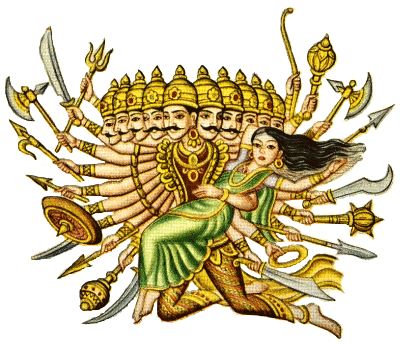 |
| Ravana with Sita |
He was the supreme ruler of the world and was known as a tormenter. He was worshiped and served out of fear, and is the ideal antagonist. When he falls in love with the vision of Sita he goes mad and plans to trick Rama, which led to one of the most intense moments in the story thus far: the fight between the great bird Jatayu and Ravana. This was one of my favorite moments in the story as I visualized a giant ten headed monster fighting a great great eagle. It was very intense, and ended in the death of Jatayu as his wings are severed from his body by Ravana. This must have been a devastating loss for Rama because Jatayu had been a friend of Dasharatha, Rama’s father. I am very excited to continue reading on in the Ramayana and see what unfolds between Ravana and Rama!


Tuesday, January 20, 2015
Week 2 Reading Diary A: The Tales of Viswamithra, and the Character of Rama
Week 2 Reading Diary A: The Tales of Viswamithra, and the Character of Rama
One of the most interesting parts in this first reading is Rama’s journey with Viswamithra as well as the betrayal of Rama by Kaikeyi. The tales Viswamithra tells Rama and Lakshmana as they are travelling were very interesting. The tale of Thataka was one of my favorites seeing how she was turned into an asura, and the imagery of her demon form. The battle between Thataka and Rama was quick, but really is what began to draw me to Rama as a character.
 |
| Rama defeating Thataka |
The story of Ahalya was also one of my favorites as it showed a classic story of lust getting the better of a man. Indra’s obsession with Ahalya ended with every inch of his body being covered with the female organ! What an embarrassing punishment to a god that must have been. Thankfully Guatama allowed these embarrassing features to become eyes, which took away Indras shame.
 |
| Indra the thousand eyed god |
Another section I enjoyed reading was Kaikeyi’s betrayal. Kaikeyi’s greed got the best of her as she found herself in a position where she may lose her position as queen and she betrayed Rama forcing him to the forest so her son Bharatha could be king. This betrayal added an intense dramatic element to the story as the king dies of grief and Bharatha grows enraged with his mother Kaikeyi for her deceitfulness.
 |
| Kaikeyi deceiving Dasharatha |

Throughout this reading I really began to enjoy reading about Rama and his many deeds. He possessed man admiral traits: strength, handsomeness, intelligence, and was very moral. Not only did he possess these traits but he was a man of action. First he captured Sita’s heart with his handsomeness and caused her to become sick with passion for him. Then he won her hand in marriage with his great strength as he strung Shiva's bow (and broke it), which was a feat no man had been able to accomplish. He even willingly allowed himself to be exiled so that his father would not go back on a promise he made to Kaikeyi.
 |
| Rama breaking Shiva's bow |
Subscribe to:
Posts (Atom)